
rediffGURU Ulhas Joshi answers your mutual fund queries.

Regardless of market levels, invest in stocks and equity mutual funds in a staggered manner.
Flexi-cap mutual fund schemes have attracted nearly Rs 50,000 crore in net inflows during January-July 2026, a 27 per cent increase year-on-year, as investors increasingly favour dynamic equity strategies.

The tax treatment of equity savings funds makes them appealing, especially to investors in higher income-tax brackets.

Cash holdings of equity mutual fund (MF) schemes moderated in September amid a slowdown in fresh inflows. Equity MF schemes held cash worth Rs 1.76 trillion at the end of September 2025 - about Rs 400 crore lower than the previous month, according to a report by Nuvama Alternative & Quantitative Research.

At Rs 4.07 trillion, gross inflows were just shy of the record Rs 4.34 trillion mobilised in H2 of 2024, making it the second half-yearly period in which inflows crossed Rs 4 trillion.

Jio BlackRock Asset Management Pvt Ltd, a 50:50 joint venture between Jio Financial Services Ltd (JFSL) and US-based BlackRock, has received regulatory approval from the capital market regulator Sebi to commence operations as an investment manager for its mutual fund business. The Securities and Exchange Board of India (Sebi), vide letter dated May 26, 2025, has granted the certificate of registration to 'Jio BlackRock Mutual Fund' and approval to Jio BlackRock Asset Management Private Limited to act as the Asset Management Company for Jio BlackRock Mutual Fund, JFSL said in a regulatory filing.

Restoration of indexation benefits on debt mutual funds, rationalisation of taxation for alternative investment funds are some of the demands.

Largecap, flexicap, and balanced advantage funds together recorded a net inflow of Rs 9,363 crore in August, representing a 70% increase from the previous month's total.

In November, six primary market issuances accounted for more than 13,000 crore of net equity investments by MFs.

Active and passive funds offer different advantages across market-cap segments, making a mix of both a sensible portfolio strategy.

Buying silver on Dhanteras may carry cultural significance, but investors should not confuse the tradition with a financial strategy.

For the first time in a decade, inflows into equity mutual funds (MFs) decoupled from the past performance of the equity market, as investors continued to pour money into the market unperturbed by lacklustre returns.
Mutual fund industry extended its bull run in 2025, adding a staggering Rs 14 lakh crore to its asset base and pushing total AUM to a record Rs 81 lakh crore by November, powered by surge in retail participation and record SIP inflows. Venkat Chalasani, chief executive officer of AMFI, told PTI that the industry's outlook remains positive, with steady SIP inflows continuing to offset foreign portfolio investor outflows and strengthening market resilience.
Net investments into equity mutual fund schemes in India remained elevated at approximately 38,440 crore in April, despite a slight dip from March's high and a 3% month-on-month decline in Systematic Investment Plan (SIP) inflows.

Mutual fund investment through systematic investment plans (SIPs) has surged to an all-time high of Rs 3.34 lakh crore in 2025, driven by growing investor appetite for disciplined, long-term wealth creation.
Leading mutual fund executives advise investors to prioritise valuations, long-term earnings potential, and asset allocation over chasing recent market winners, as global uncertainty reshapes investment opportunities. They caution against decisions based solely on recent returns and advocate for portfolios built on fundamentals.
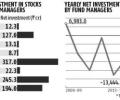
After relentlessly selling shares for most of 2013, India's equity mutual fund managers have turned buyers in the fag-end of the year.

'If their allocation to certain segments have become high due to strong returns over the past three-four years, they should rebalance their portfolios and bring them in line with their long-term asset allocation.'

'The rise in SIP contributions has created a pool of long-term MF assets that can be pledged for loans.'

IT services stocks have had tough two years, with prices coming under pressure from 2025 and the sell-off extending through the first half of 2026.

The number of companies had touched a low of 792 in July 2020 amid heightened uncertainty because of COVID-19.

'Since the category has a limited track record, assess the fund manager's experience across equity and debt market cycles rather than relying only on past returns.'

Smallcap funds have emerged as the primary beneficiaries of the systematic investment plan (SIP) wave in Indian mutual funds over the past five years, with their SIP assets surging to approximately 1.83 trillion by March 2026, a fivefold increase.

If India does get $100 billion a year in FDI, it would be a game-changer in every possible way. FPIs would come rushing back, AI or no AI, points out Debashis Basu.

Systematic Investment Plan (SIP) account registrations in India fell to an 18-month low of 5.1 million in October, while closures surged to 5.9 million, the highest since April 2025, leading to a decline in active SIP accounts and monthly contributions.

It's time to start planning your tax investments. Here are some new tax saving funds funds that have hit the market.

rediffGURU Vivek Lala answers your income tax and personal finance queries.

AUM heavyweights SBI, HDFC and ICICI Pru flex muscle, adding Rs 2 trillion+ each.

The factor fund launch spree by mutual funds (MFs) is moving from the passive to the active space. Two new fund offerings (NFOs) - ICICI Pru Active Momentum Fund and Bandhan Multi-Factor Fund - are currently open for subscription. Sundaram MF's multi-factor fund NFO closed this Wednesday.

'There is always room for good companies to go public and list. As long as good companies are listing and holding good valuations, the market will be vibrant.'

A primer on tax you pay on your mutual fund gains

"When you have more liquidity than good investment opportunities, there is no reason for MFs to sell a winning trade."

Net inflows into equity mutual fund schemes moderated in FY26, falling by 27 per cent to about 3 trillion till February, as choppy markets and global uncertainties prompted investors to shift towards safer options like hybrid funds and gold ETFs.

Domestic institutional investors (DIIs) made record net purchases of 8.55 trillion in the Indian equity market during Samvat 2082, significantly offsetting the highest-ever net selling by foreign portfolio investors (FPIs) who withdrew 4.55 trillion amidst global turmoil and a shift towards AI-focused firms.
Equity funds like to identify newer avenues of investment and hence they create products around those new avenues. In the second part of this series, we look at the styles and themes of MFs.

Capital markets regulator Sebi has permitted mutual funds to again invest in foreign stocks within the aggregate mandated limit of $7 billion for the industry. This came in the wake of a major correction in global markets that brought down the valuation of international stocks. In January, Sebi had asked mutual fund houses to stop taking fresh subscriptions in schemes investing in overseas stocks. The directive to stop subscription was mainly on account of the mutual fund industry crossing the mandated limit of $7 billion for overseas investments.

Liquidity stress in smallcap funds has fallen to its lowest level since February 2024, with the average time to liquidate 50% of portfolios dropping to 27 days in June from a peak of 44.2 days in January 2026, driven by a sharp recovery in smallcap stocks and increased trading volumes.

'Growth for some companies has been hard to come by and this is a smart way to get there.'
